
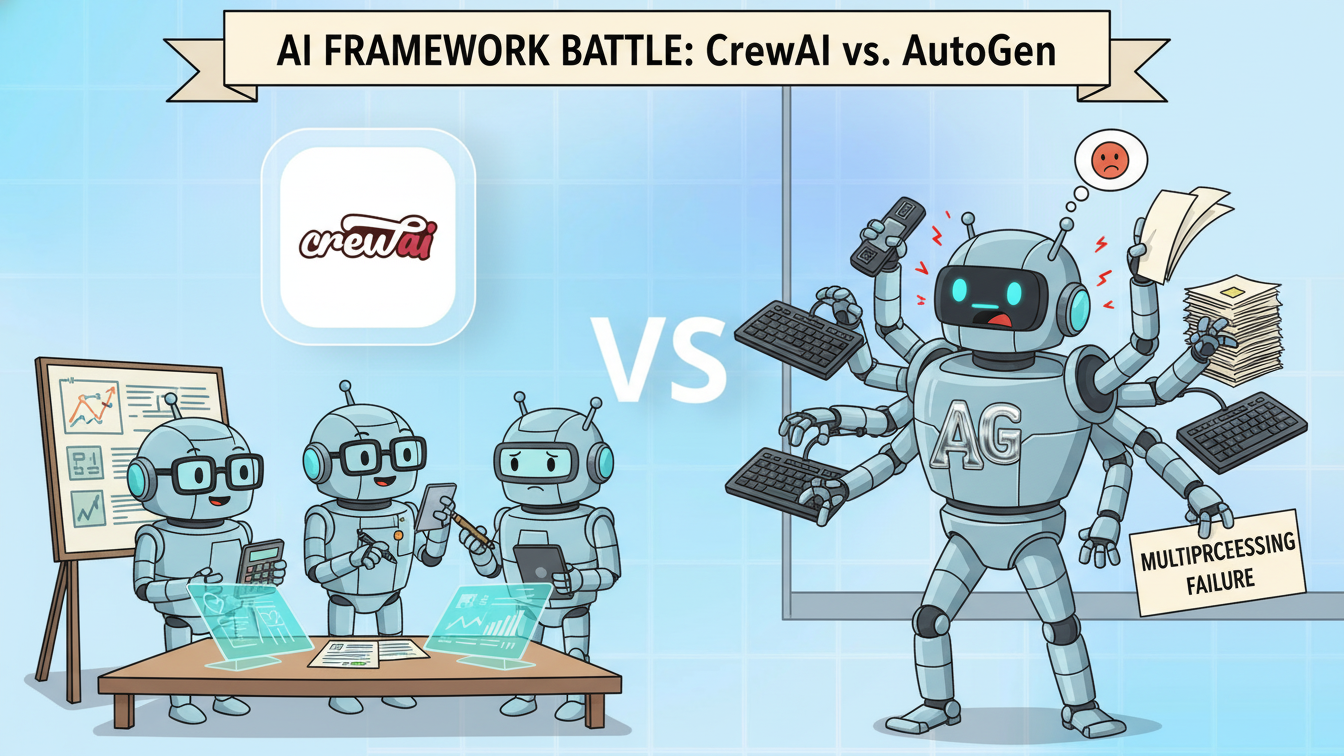

The agentic revolution is here, and it demands that we move beyond asking a single LLM a question and start thinking about building entire autonomous teams. CrewAI and AutoGen are the two heavyweight champions leading this charge, but they cater to very different engineering mindsets.
The Core Philosophical Split:
- CrewAI embodies the Team Manager philosophy. It is focused on structured workflows where agents have predefined Roles, clear Goals, and a set sequence of tasks—much like a highly efficient human team operating under strict standard operating procedures (SOPs).
- AutoGen embodies the Conversational Problem Solver philosophy. It is centered around dynamic, peer-to-peer negotiation and dialogue, allowing agents to critique, correct, and collaborate in real time. It is best suited for scenarios where the solution is an emergent property of conversation. The true winner depends entirely on your project’s specific needs—structure or spontaneity.
Category Deep Dive: CrewAI vs. AutoGen
| Feature |
CrewAI Framework Review
|

AutoGen (Microsoft) Review
|
|---|---|---|
| Overall Rating | 8.5/10 | 8.7/10 |
| Performance & Output Quality | 9.0/10 | 9.0/10 |
| Capabilities | 9.0/10 | 9.5/10 |
| Ease of Use | 7.0/10 | 7.0/10 |
| Speed & Efficiency | 8.0/10 | 8.0/10 |
| Value for Money | 9.0/10 | 9.0/10 |
| Innovation & Technology | 8.0/10 | 9.0/10 |
| Safety & Trust | 9.5/10 | 9.5/10 |
| Get CrewAI | Try AutoGen |
Speed and Efficiency Winner: CrewAI Edges Out AutoGen in Predictable Token Use
Both frameworks deliver highly optimized solutions. However, when we dive into the token count, CrewAI takes the win for workflows that are known and deterministic.
| Category Winner: | CrewAI (For Predictable Token Use) |
|---|---|
| CrewAI Advantage: | Generally faster for known, deterministic workflows due to its structured approach and less conversational overhead. API costs are more predictable. |
| AutoGen Caveat: | Can be slower because of conversational turns (Agent A asks for critique, Agent B replies, Agent A corrects), but this complexity is necessary for its core function. |
| Key Metric: | Cost/Token Count for a Standard Market Analysis Report. CrewAI’s guided flow results in lower, more predictable token usage because the LLM isn’t debating the next step—it’s following instructions. |
For engineers managing large-scale operations, predictable cost is often more valuable than raw speed. CrewAI’s structured mandate—Agent 1 passes to Agent 2—translates directly to fewer redundant LLM calls. AutoGen, while powerful, generates more verbose chat logs, and every back-and-forth correction adds to your token bill. If you’re running a million of these reports a month, that conversational overhead matters.
Safety and Trust Winner: AutoGen’s Built-In Security is a Game-Changer
When an LLM writes code, security is paramount. Since both frameworks are designed to execute Python or Shell scripts, the question is how they handle the risk of arbitrary code execution. AutoGen delivers a decisive victory here with its native, opinionated approach to security.
| Category Winner: | AutoGen (For Native Security) |
|---|---|
| AutoGen Advantage: | AutoGen provides native support for running code in isolated environments (like Docker containers) as a core part of its design, significantly reducing the security risk during code generation tasks. |
| CrewAI Requirement: | CrewAI requires external setup/tools (like running the entire CrewAI process within a separate Docker container or virtual machine) for secure code isolation, adding an extra layer of complexity for the developer. |
| The Human Touch: | If you’re a data scientist, you want your agent to analyze local CSV files, but you don’t want a bad hallucination to potentially wipe your working directory. AutoGen’s built-in isolation gives developers the confidence they need to deploy autonomous code execution without fear. |
Value for Money Winner: Tie, But CrewAI is the Better Budget Forecaster
Both frameworks are free, open-source projects, offering immense value. The TCO (Total Cost of Ownership) relies solely on the LLM API costs (OpenAI, Anthropic, etc.) and your cloud infrastructure.
| Category Winner: | Tie (Both are Free/Open-Source) |
|---|---|
| TCO Driver: | The TCO relies solely on the LLM API costs (OpenAI, Anthropic, etc.) and your cloud infrastructure. |
| Budgeting Advantage: | CrewAI’s structured nature often leads to more predictable API costs for deterministic tasks. If you run the same crew twice, you should get a near-identical token usage. |
| The Verdict: | For a startup or small team watching their API budget like a hawk, CrewAI offers peace of mind. While both offer immense value by being free, CrewAI offers an easier path to cost predictability, turning “Value for Money” into “Budget Control.” |
Capabilities Winner: AutoGen’s Dynamic Negotiation
While CrewAI is exceptional at task delegation, AutoGen’s approach to conversational negotiation unlocks a different level of complex, emergent problem-solving. This is where AutoGen pulls ahead.
| Category Winner: | AutoGen (For Dynamic Negotiation) |
|---|---|
| AutoGen Method: | Excels at Dynamic Chat and Negotiation. It allows agents to disagree and self-critique, leading to a more robust, “peer-reviewed” solution. |
| CrewAI Method: | Excels at Delegation (Agent A passes output to Agent B). Strong in Hierarchical Workflows. |
| Example: | If an AutoGen agent writes buggy code, another agent can chime in: “Wait, you forgot to import the library on line 5. Please correct and re-run.” This spontaneous debate is powerful. |
Innovation & Technology Winner: AutoGen’s Conversational Orchestration
Both frameworks are highly innovative. CrewAI innovates by making multi-agent systems accessible through a familiar business model (team roles), but AutoGen’s technology is a more direct advancement of the core agent paradigm.
| Category Winner: | AutoGen (For Conversational Orchestration) |
|---|---|
| AutoGen Innovation: | Focuses on Conversation-Driven Orchestration, pioneering the use of dynamic, peer-to-peer negotiation and self-critique. It represents a truer form of autonomous collaboration. |
| CrewAI Innovation: | Focuses on Flows (business process modeling) and accessibility. Its strong integration with LangChain means it’s often building on existing infrastructure. |
| The Differentiator: | AutoGen’s conversational architecture is a direct evolutionary step from early models like BabyAGI, focusing on making the entire workflow an autonomous, self-steering discussion. |
Strategic Angle: Human-in-the-Loop (HITL) Score
For mission-critical applications, the ability for a human to audit and intervene is essential. AutoGen’s chat-based design provides an inherently better reasoning trace.
| Framework | Reasoning Trace & Intervention |
|---|---|
| CrewAI Trace: | Provides a clear, sequential log of Agent Thoughts and Task execution. Intervention is easily managed between tasks (at defined checkpoints). |
| AutoGen Trace (Superior): | Superior due to its conversational nature. The continuous chat log between agents is the reasoning trace, allowing the human to seamlessly join the conversation and interject a fix or new instruction at any moment, almost like jumping into a live Slack thread. |
The Final Verdict and Decision Guide
Choosing between these two frameworks is the most important architectural decision an AI engineering team will make in 2026. AutoGen may win the overall score, but CrewAI is often the better fit for enterprise predictability.
| Key Category | CrewAI (Team Manager) | AutoGen (Engineer) |
|---|---|---|
| Structured Output Reliability | Winner | Strong contender |
| Dynamic Problem-Solving | Strong contender | Winner |
| Ease of Initial Setup | Winner | Steeper Curve |
| Native Code Security | Requires setup | Winner |
| Tool Ecosystem | Winner (via LangChain) | Strong native tools |
| Cost Predictability | Winner | Variable cost |
| Best for: | Business Process/Content Automation | Code Generation/Data Analysis |
When to Choose CrewAI (The Structured Manager):
You should choose CrewAI when your task flow is known, and consistency is the priority. If you are modeling a sequence of steps—such as market research $\rightarrow$ content drafting $\rightarrow$ SEO optimization—CrewAI’s strict, role-based structure prevents wasted steps and makes your API budget predictable. It is the best choice for automating content and sales pipelines.
When to Choose AutoGen (The Autonomous Engineer):
Choose AutoGen when the task requires self-correction, debate, or complex code execution. If you are building a tool that needs to “figure out” the solution path (e.g., “Analyze the user_data.json file, identify outliers, and then visualize the trend”), AutoGen’s conversational and natively isolated code execution environment will lead to a faster, more robust final solution, even if the token count is higher.

Responses (0)
Be the first to respond.