
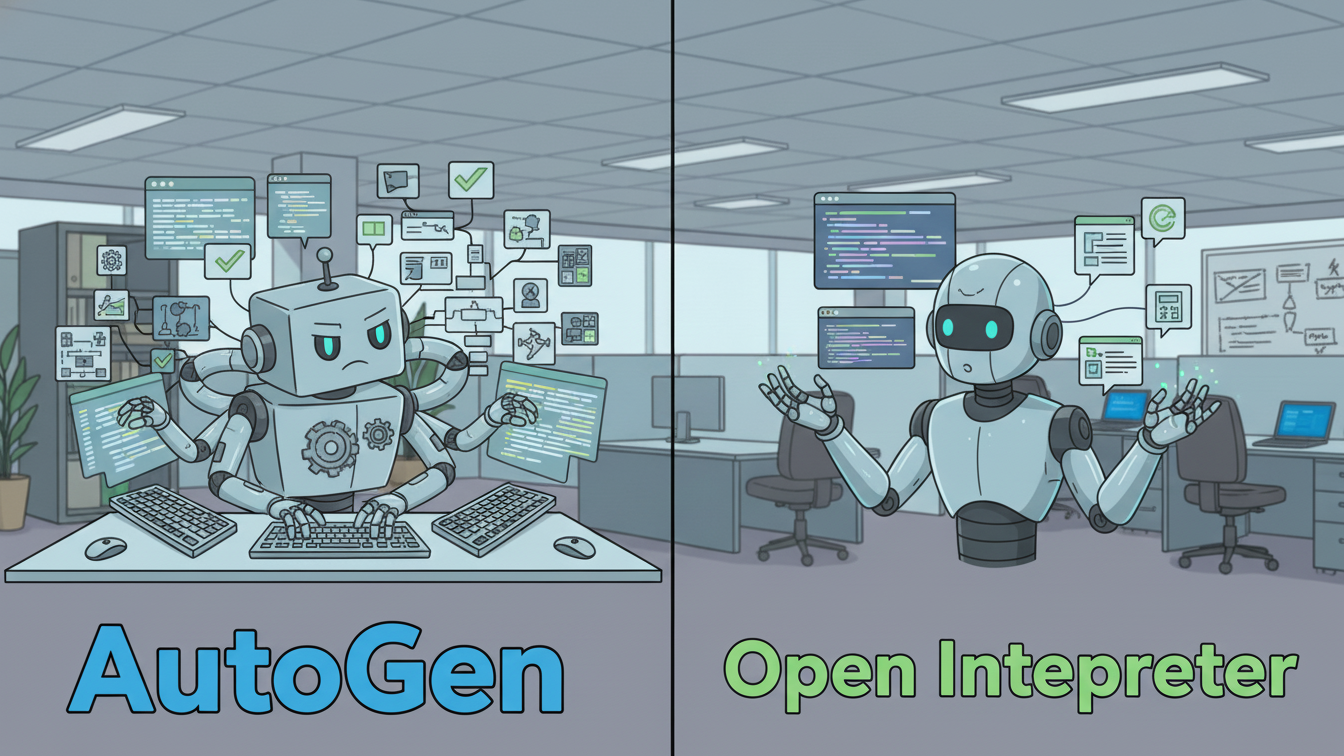

AutoGen and Open Interpreter (OI) both represent the cutting edge of autonomous AI systems, but they are built for fundamentally different purposes. While both involve code execution, their architectures dictate their safety profiles and ideal use cases.
Core Difference:
- AutoGen: The Conversational Orchestrator, a true multi-agent framework designed for debate, negotiation, and iterative problem-solving. Code execution is handled by a dedicated, optional agent (the
User_ProxyorCoder) and requires external sandboxing (like Docker) for safety. - Open Interpreter (OI): The Universal Code Execution Engine, designed as a single, powerful agent focused entirely on achieving goals by executing code (Python, JavaScript, Shell). Safety is native and built-in using secure process isolation, making code execution its core, safe competency.
This comparison is vital for engineers deciding how to safely integrate complex, autonomous computational tasks into their environments.
Comparison of Frameworks
| Feature |

AutoGen (Microsoft) Review
|

Open Interpreter Review
|
|---|---|---|
| Overall Rating | 8.7/10 | 7.8/10 |
| Performance & Output Quality | 9.0/10 | 9.0/10 |
| Capabilities | 9.5/10 | 9.5/10 |
| Ease of Use | 7.0/10 | 7.0/10 |
| Speed & Efficiency | 8.0/10 | 6.0/10 |
| Value for Money | 9.0/10 | 8.8/10 |
| Innovation & Technology | 9.0/10 | 4.0/10 |
| Safety & Trust | 9.5/10 | 10.0/10 |
| Try AutoGen | Try Open Interpreter |
Safety, Trust & Sandboxing (The Core Criterion)
The user query focuses on safety. Open Interpreter (OI) is the clear winner as secure sandboxing is not an afterthought but its primary architectural philosophy.
| Category Winner: | Open Interpreter (Native, Robust Sandboxing) |
|---|---|
| AutoGen Safety: | Code execution is safe only if an external tool (like Docker, which must be configured by the user) is deployed to wrap the execution environment. The framework does not guarantee isolation natively. |
| Open Interpreter Safety: | Native isolation is built into the core design using tools like Piston or equivalent mechanisms (depending on deployment). This makes it inherently safer for untrusted, AI-generated code execution out of the box. |
| Trust: | Low due to the high conversational volume and risk of agents “agreeing” on an incorrect path without human intervention. |
| Key Metric: | Time to Secure Deployment: OI is instant and native; AutoGen requires significant, separate configuration. |
| Architecture: |
System Architecture (Single Agent vs. Multi-Agent)
This defines the problem-solving approach. AutoGen is the superior choice for teamwork and debate.
| Category Winner: | AutoGen (True Multi-Agent System) |
|---|---|
| AutoGen Architecture: | Multi-Agent. Supports complex configurations where multiple agents (e.g., Coder, Critic, Manager, User Proxy) converse and negotiate to solve a problem. |
| Open Interpreter Architecture: | Primarily Single Agent. Functions as a single, powerful “Interpreter” that takes direction from the user and executes code to solve the goal. Does not natively support peer-to-peer agent debate. |
| Key Metric: | Complexity of Workflow Modeling: AutoGen excels at modeling complex, social workflows (like a software development team). |
Performance & Output Quality
The output quality is dictated by the agent’s ability to self-correct. AutoGen’s multi-agent critique process often leads to a better final result, despite being slower.
| Category Winner: | AutoGen (For Output Refinement) |
|---|---|
| AutoGen Output: | High potential quality due to the Critic Agent approach. Agents critique code and results conversationally, iteratively improving the output before completion. |
| Open Interpreter Output: | Good quality for direct computation, but less opportunity for internal critique. The single agent tends to trust its initial code/logic, requiring more human supervision. |
| Consistency: | AutoGen’s conversational critique increases consistency; OI relies on fewer checks. |
Capabilities (Depth of Tooling)
AutoGen uses Python function calling and conversational tools; OI uses the shell/command line as its main tool.
| Category Winner: | Tie (Different Domains of Tooling) |
|---|---|
| AutoGen Capabilities: | Excels at dynamic function calling, where the LLM selects pre-defined Python functions (tools) from a set. Ideal for structured, sequential tasks that interact with internal APIs. |
| Open Interpreter Capabilities: | Excels at unbounded code execution, allowing the agent to use any language (Python, Shell, JavaScript) to manipulate the operating system (within the sandbox). Ideal for generalized computational tasks. |
| Niche Specialization: | AutoGen for structured, internal automation; Open Interpreter for open-ended code analysis and execution. |
Integration & Compatibility
AutoGen is built on top of the conversational LLM paradigm, whereas OI is built on top of the OS shell, giving it different compatibility strengths.
| Category Winner: | AutoGen (For LLM/API Ecosystem) |
|---|---|
| AutoGen Integrations: | Strong compatibility with various LLM providers (OpenAI, Azure, local models) and excellent integration with LangChain’s tool ecosystem via the function_calling structure. |
| Open Interpreter Integrations: | Primarily focused on OS integration. Connects with the shell environment to use command-line tools (e.g., git, pip, wget). External API integration requires the agent to write and execute Python code. |
| Key Metric: | External Tool Access: AutoGen is better for structured tool APIs; OI is better for unstructured shell commands. |
Customization & Control
AutoGen’s architecture is complex but highly modular, granting developers fine-grained control over the system’s behavior.
| Category Winner: | AutoGen (For Developer Control) |
|---|---|
| AutoGen Control: | High low-level control over chat behavior, agent roles, system messages, conversation flow, and termination conditions. Developers must manage all agent states. |
| Open Interpreter Control: | Control is focused on the user interaction layer (e.g., auto-run flags, model selection). Developers have less direct control over the core execution engine’s internal planning loop. |
| Key Metric: | System Modeling Flexibility: AutoGen allows for modeling complex agent social dynamics (like negotiation and conflict resolution). |
Ease of Use / User Experience
The installation complexity of AutoGen’s multi-agent system is higher than OI’s single-agent, CLI-focused approach.
| Category Winner: | Open Interpreter (For Single-Task Focus) |
|---|---|
| AutoGen UX: | Steeper Learning Curve. Requires defining multiple agents, their roles, communication patterns, and termination conditions, adding complexity to setup. |
| Open Interpreter UX: | Lower Learning Curve. Simple CLI installation and operation; the user interacts directly with the Interpreter agent in a clear chat window. |
| Time to First Successful Task: | Open Interpreter is generally faster to get started for a single computational task. |
Speed & Efficiency
The complexity of multi-agent negotiation adds conversational overhead to AutoGen, making OI faster for direct computation.
| Category Winner: | Open Interpreter (For Direct Computation) |
|---|---|
| AutoGen Efficiency: | Lower efficiency. Execution is slowed by conversational overhead (agents debating the next step) and requires multiple LLM calls per conceptual step. |
| Open Interpreter Efficiency: | Higher efficiency. The agent moves quickly from planning to execution with minimal conversational loops, resulting in faster resolution of computational tasks. |
| Cost Predictability: | Poor for both, but AutoGen’s conversational nature makes costs even harder to predict than OI’s more direct execution path. |
Value for Money
Both are free open-source projects, but the efficiency difference impacts the long-term API cost (TCO) for users.
| Category Winner: | Open Interpreter (Lower TCO for Execution) |
|---|---|
| Pricing Model: | Both are free and open-source (MIT License). Costs are only associated with underlying LLM usage. |
| TCO (Total Cost of Ownership): | AutoGen’s tendency for prolonged agent chats drives up API costs faster. OI, by being more direct in its computation, generally offers a lower TCO for core execution tasks. |
| Community Value: | Both have large, active communities, providing excellent free support and continuous development. |
Strategic Angle: Observability (Reasoning Trace)
Observability is key to debugging and trusting autonomous systems, especially those executing code.
| Framework | Observability Score | Reasoning Trace & Intervention |
|---|---|---|
| AutoGen | ⭐⭐⭐ 7/10 | The entire chat log between agents acts as the reasoning trace. This is excellent for following the debate, but the sheer volume of conversation can make audit and debugging cumbersome. |
| Open Interpreter | ⭐⭐⭐⭐ 8/10 | Superior. Clearly segregates the thought process (internal monologue) from the code execution (shell output). This clean separation makes it easier to audit which command the AI decided to run and why. |
Check out the best autonomous AI agents for business automation.
Conclusion and Decision Guide
The optimal choice depends entirely on whether the priority is guaranteed safety for single, complex computational tasks (Open Interpreter) or collaborative problem-solving (AutoGen).
| Key Category | Winner |
|---|---|
| Native Code Safety/Sandboxing | Open Interpreter |
| Multi-Agent Collaboration | AutoGen |
| Output Quality (Refinement) | AutoGen |
| Ease of Initial Setup | Open Interpreter |
| Task Speed (Computational) | Open Interpreter |
| Customization & Control | AutoGen |
| Best for Computational TCO | Open Interpreter |
When to Choose Open Interpreter (The Safe Coder):
Choose Open Interpreter when your main goal is to securely execute AI-generated code (Python, Shell, etc.) to manipulate files, run local commands, or perform open-ended data analysis, and the safety of the host machine is paramount.
When to Choose AutoGen (The Conversational Team):
Choose AutoGen when you need a team of specialized AIs to debate, critique, and collectively arrive at a solution. Use it for complex software development, scientific modeling, or structured workflows where safety is delegated to a pre-configured Docker environment.



I get what you are saying but these are basically the same product.
AutoGen is the safer system without a doubt