
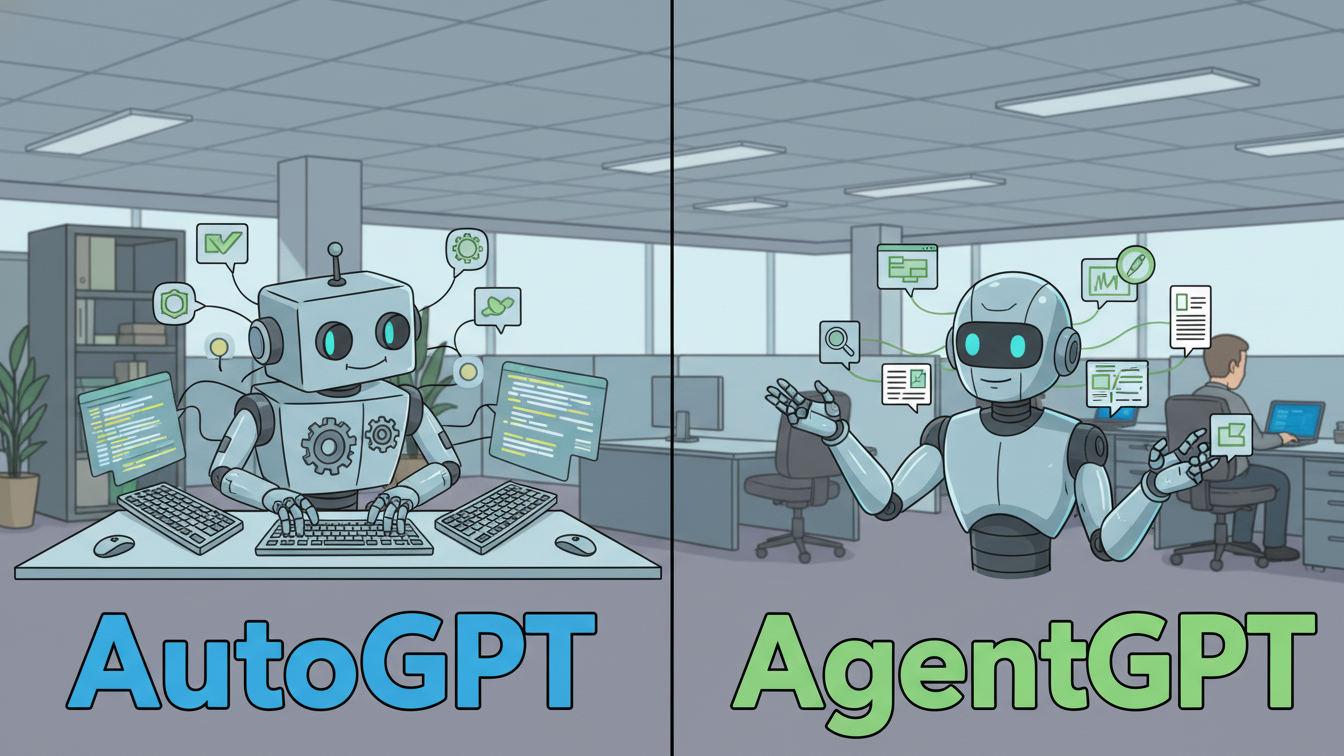

AutoGPT and AgentGPT were the initial vanguards of the autonomous agent movement. Both pioneered the continuous execution loop—where an AI repeatedly generates tasks, prioritizes them, and executes them until a goal is met.
The primary difference between the two is in their implementation and target audience:
- AutoGPT is the Command-Line Original, often requiring a technical setup (Docker or CLI) but offering deeper customization and code execution capabilities for complex research tasks.
- AgentGPT is the Web-UI Demonstrator, offering extreme ease of use and visual clarity, making it the perfect starting point for visualizing the agent loop.
This comparison is tailored for researchers, developers, and students looking for the best free, open-source tool for open-ended, exploratory problem-solving.
Comparison of Frameworks
| Feature |

AutoGPT Next Review
|

AgentGPT Review
|
|---|---|---|
| Overall Rating | 8.2/10 | 5.1/10 |
| Performance & Output Quality | 8.0/10 | 3.5/10 |
| Capabilities | 9.0/10 | 4.0/10 |
| Ease of Use | 7.0/10 | 9.0/10 |
| Speed & Efficiency | 8.0/10 | 3.0/10 |
| Value for Money | 9.0/10 | 5.0/10 |
| Innovation & Technology | 7.0/10 | 1.5/10 |
| Safety & Trust | 9.5/10 | 9.5/10 |
| Get AutoGPT | Get Product |
Performance & Output Quality
Both open-loop agents struggle with consistency and often get stuck in recursive loops. AutoGPT is marginally more stable due to its deeper memory management capabilities.
| Category Winner: | AutoGPT (Marginally More Stable) |
|---|---|
| AutoGPT Output: | Slightly higher potential quality for detailed outputs, especially those involving file manipulation or code execution, but still highly inconsistent due to the open-loop design. |
| AgentGPT Output: | Tends to be less robust and more susceptible to prompt drift. Outputs are almost exclusively unstructured text, making them difficult to parse programmatically. |
| Key Metric: | Task Looping Frequency: Both are high, but AutoGPT has better community-driven fixes for common loops. |
Capabilities (Depth and Breadth)
AutoGPT, being the older and more heavily customized project, boasts a wider range of pre-built modules and integration potential.
| Category Winner: | AutoGPT (More Configurable Tools) |
|---|---|
| AutoGPT Capabilities: | Excels at self-contained research and development tasks, featuring better native support for code generation, file reading/writing, and limited API interaction. |
| AgentGPT Capabilities: | Primarily excels at web searching and basic text generation. Its core capability is visualizing the agent process for learning purposes. |
| Niche Specialization: | AutoGPT for technical R&D and scripting; AgentGPT for educational visualization and quick demos. |
Ease of Use / User Experience
AgentGPT is unequivocally the easiest to start due to its simple web interface. AutoGPT requires technical familiarity with CLI or Docker.
| Category Winner: | AgentGPT (Web Interface Simplicity) |
|---|---|
| AutoGPT UX: | Steeper Learning Curve. Requires setup of Python environment or Docker, configuration via .env files, and interaction via command line. |
| AgentGPT UX: | Lowest Learning Curve. Purely web-based. Requires only a browser and an API key (if self-hosting). |
| Time to First Deployment: | AgentGPT is generally faster to run the first task successfully. |
Speed & Efficiency
Both frameworks are notoriously slow and token-inefficient because the agent is forced to call the LLM to prioritize its entire task list after every single step, creating excessive conversational overhead.
| Category Winner: | Tie (Both are Highly Inefficient) |
|---|---|
| AutoGPT Efficiency: | Token consumption is high and unpredictable, but developers have slightly more control over the memory length, which can temper costs slightly. |
| AgentGPT Efficiency: | Similarly high token consumption. The web visualization, while great for learning, adds cognitive steps that translate to more LLM calls. |
| Cost Predictability: | Very low for both; TCO is significantly higher than structured alternatives like CrewAI. |
Value for Money
As both are free, open-source projects, the value is tied to their utility as learning tools versus their Total Cost of Ownership (TCO) in production.
| Category Winner: | Tie (Exceptional Free Value, Poor TCO) |
|---|---|
| Value Proposition: | Both are free and open-source (MIT License). They provide immense value as conceptual blueprints for agent autonomy. However, AgentGPT offers a Pro plan for $40 and a Enterprise plan which is customizable based on the clients needs. |
| Refinement: | Both frameworks are prone to high, unpredictable API costs (TCO) for complex tasks, making them cost-inefficient compared to highly optimized sequential frameworks. |
Integration & Compatibility
AutoGPT’s foundation in the command line allows it to integrate better with local shell commands and a wider array of custom Python modules.
| Category Winner: | AutoGPT (Better CLI/Local Integration) |
|---|---|
| AutoGPT Integrations: | Stronger capacity for local tool integration, connecting to local APIs, and executing custom shell scripts. |
| AgentGPT Integrations: | Primarily limited to web-based interactions (web search, data scraping). Does not easily integrate with local computational tasks. |
| Key Metric: | Local Code Execution Robustness: AutoGPT is more robust for this task, though safety remains a concern for both. |
Customization & Control
AutoGPT offers much greater customization through its command-line arguments, Docker configurations, and a more modular codebase for developers looking to modify core behavior.
| Category Winner: | AutoGPT (For Developer Control) |
|---|---|
| AutoGPT Control: | High control over memory size, LLM model choice, and the ability to define custom commands and functions through the codebase. |
| AgentGPT Control: | Control is limited mainly to setting the initial goal and observing the process through the user interface. |
Safety & Trust
Since both frameworks are designed around the concept of an LLM writing and executing arbitrary code, the security risk is inherently high for both.
| Category Winner: | Tie (Both are High Risk) |
|---|---|
| AutoGPT Safety: | Requires external sandboxing (like running in a dedicated Docker container) to mitigate the risk of LLM-generated code running malicious commands on the host machine. |
| AgentGPT Safety: | Similar high risk. Requires the same external sandboxing measures; often, the web-UI makes it deceptively easy to use without considering the underlying security implications. |
Innovation & Technology
Both are highly innovative projects that contributed fundamentally to the modern agent landscape.
| Category Winner: | Tie (Defined the Autonomous Agent Architecture) |
|---|---|
| AutoGPT Innovation: | Pioneered the original concept of the fully autonomous, self-prompting AI agent that transcended simple sequential chains. |
| AgentGPT Innovation: | Defined the visual and accessible user experience for the autonomous agent, making the complex concept graspable by non-developers. |
Strategic Angle: Human-in-the-Loop (HITL) Score
The ability for a human to track and intervene when the agent gets stuck is crucial for these unpredictable systems.
| Framework | Human-in-the-Loop Score | Reasoning Trace & Intervention |
|---|---|---|
| AutoGPT | ⭐⭐ 5/10 | Trace is primarily text-based CLI output. While a human can interrupt, monitoring the agent’s long-term thought process is less intuitive than a visual trace. |
| AgentGPT | ⭐⭐⭐ 7/10 | Superior due to its visual interface, which clearly displays the active task list, the execution trace, and memory. This visual transparency makes error identification and intervention simpler. |
Checkout the Best Autonomous AI Agents for Business Automation.
Conclusion and Decision Guide
The choice hinges on whether you prioritize usability and visualization (AgentGPT) or technical control and tool depth (AutoGPT).
| Key Category | Winner |
|---|---|
| Ease of Initial Setup | AgentGPT |
| Exploratory Research Depth | AutoGPT |
| HITL/Visual Monitoring | AgentGPT |
| Customization & Control | AutoGPT |
| Code Execution & APIs | AutoGPT |
| Best for Beginners/Demos | AgentGPT |
When to Choose AgentGPT (The Visual Starter):
Choose AgentGPT if you are new to autonomous agents, need to demonstrate the core concept to a non-technical audience, or are only performing light, web-based research where visualization is the priority.
When to Choose AutoGPT (The Technical Explorer):
Choose AutoGPT if you are a developer, are comfortable with command-line tools, and require deeper configuration, local code execution capabilities, or a wider range of integrated tools for complex, file-based, or technical research tasks.

Responses (0)
Be the first to respond.