
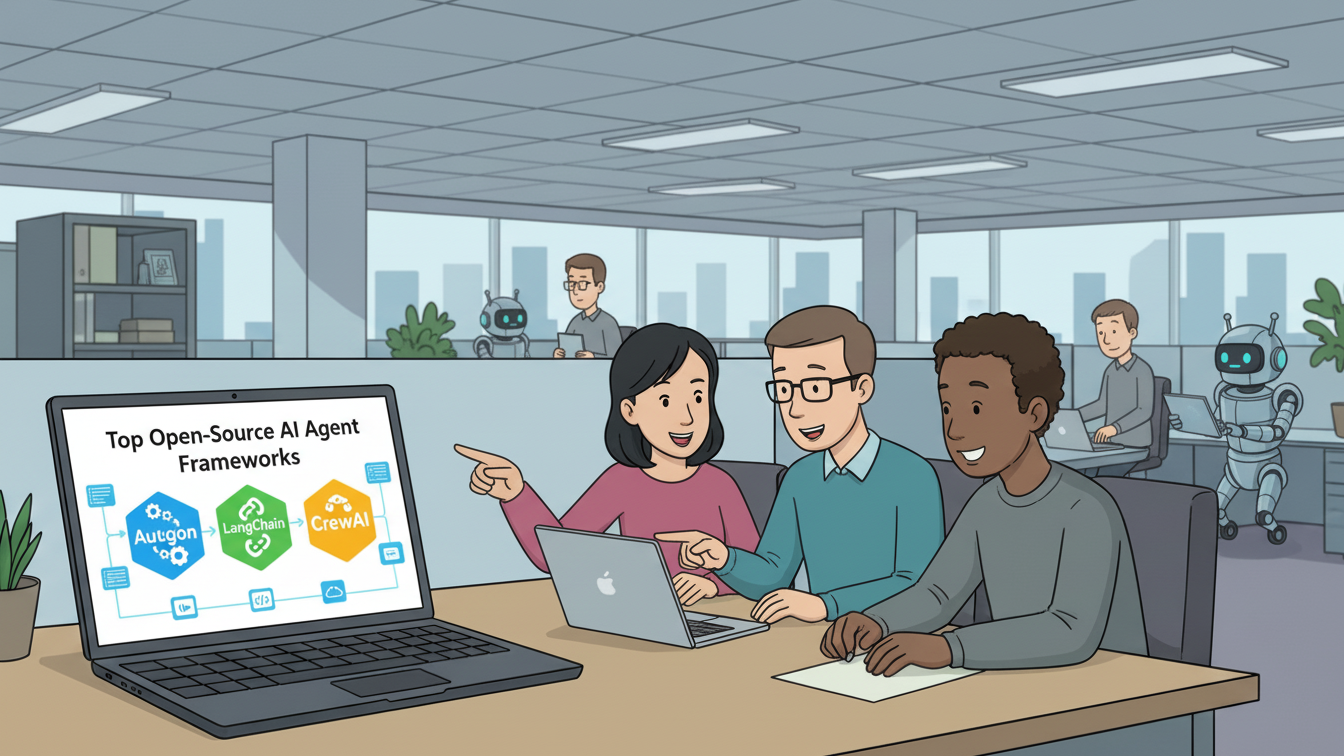

I’ve spent many late nights spinning up agents: some for personal automations, others for small-team pilots, and a few as proofs-of-concept for clients. I also watched discussions on GitHub, Reddit, and dev forums where people share battle stories and lessons. Based on that mixture of hands-on use and community wisdom, here are the top 5 open-source AI agent frameworks I believe matter in 2026 — especially for developers, startups, or operations teams looking to build custom automation pipelines.
For each framework: what it is, what it does well (and not so well), who should use it — and a bit of honesty about gotchas.
What I mean by “open-source AI agent framework”
By that I refer to publicly available software/toolkits (on GitHub or similar) that let you build autonomous or semi-autonomous “agents.” These agents can orchestrate tasks over multiple steps, call tools or APIs, maintain memory or state, and in the better frameworks — support multi-agent coordination.
These differ from closed, SaaS-only “agent platforms”: with open-source frameworks, you get code access, freedom to self-host, full control over integrations, and in many cases — flexibility to customize for your needs. But that freedom comes with responsibility: you often need engineering effort, monitoring, and custom integration work.
My evaluation criteria
When deciding which agent frameworks to spotlight, I weighed:
- Popularity & community support — active repos, many contributors/users, forks & people talking about them.
- Flexibility — ability to integrate with external tools, APIs, databases, or custom code.
- Support for multi-step workflows, memory & state — so agents can do more than one-off tasks.
- Multi-agent support (if relevant) — ability to orchestrate several agents with roles or coordination.
- Ease of getting started vs. capacity for production usage — from simple experiments to more serious deployments.
| Feature |

LangChain Agents Framework Review
|

AutoGPT Next Review
|

AutoGen (Microsoft) Review
|

CrewAI Framework Review
|

AgentGPT Review
|
|---|---|---|---|---|---|
| Overall Rating | 8.4/10 | 8.2/10 | 8.7/10 | 8.5/10 | 5.1/10 |
| Performance & Output Quality | 8.0/10 | 8.0/10 | 9.0/10 | 9.0/10 | 3.5/10 |
| Capabilities | 9.5/10 | 9.0/10 | 9.5/10 | 9.0/10 | 4.0/10 |
| Ease of Use | 6.0/10 | 7.0/10 | 7.0/10 | 7.0/10 | 9.0/10 |
| Speed & Efficiency | 8.0/10 | 8.0/10 | 8.0/10 | 8.0/10 | 3.0/10 |
| Value for Money | 9.0/10 | 9.0/10 | 9.0/10 | 9.0/10 | 5.0/10 |
| Innovation & Technology | 8.5/10 | 7.0/10 | 9.0/10 | 8.0/10 | 1.5/10 |
| Safety & Trust | 9.5/10 | 9.5/10 | 9.5/10 | 9.5/10 | 9.5/10 |
| Try LangChain | Get AutoGPT | Try AutoGen | Get CrewAI | Get Product |
The Top 5 Open-Source Agent Frameworks
AutoGen — Scalable multi-agent orchestration and conversational pipelines

What AutoGen is about
AutoGen is a more “developer-oriented” multi-agent framework. It enables building systems where agents can engage in conversations, collaborate, pass messages, and coordinate to complete tasks.
Why it stands out (for more advanced use cases)
- Good for scenarios requiring structured collaboration: e.g. decision-making workflows, multi-stage analysis, QA / review, agent-to-agent coordination.
- Built with flexibility — supports custom logic, integrations, memory, and agents as first-class actors.
Use-cases I’ve tried / seen work well
- An analytical pipeline: I used AutoGen to build a “market-research + SWOT + summary” agent chain. One agent collected data, another structured it, a third wrote a summary; the pipeline ran largely unattended, with only high-level oversight.
- A decision-support system: a chain of agents that gather data, evaluate options, and produce a ranked recommendation — useful for product roadmap planning or internal analysis.
Strengths
- Designed for serious workflows: more robust than quick experiments.
- Great for automation that requires reasoning, agent communication, memory and branching logic.
- Scalable: can be extended to multi-agent teams, asynchronous flows, complex pipelines.
Caveats / What to plan for
- Requires engineering effort: you need developer time, integration work, monitoring.
- With greater power comes greater need for observability: without logging, tracing, evaluation infrastructure — you may lose track of what agents did. This was a lesson echoed many times by people on dev forums.
- Potential for loops or “agent confusion” if logic/rules aren’t defined carefully.
Who should pick AutoGen
- Teams or developers building mid-to-complex agent-based automations: workflows that need coordination, memory, tool integration, decision logic.
- Situations where you want a “real” automated pipeline (not hacky experiments) and have resources to build infrastructure around it.
CrewAI — Multi-agent collaboration & role-based orchestration

What CrewAI is (concept)
CrewAI is built around the concept of multiple agents with distinct roles (e.g. researcher, writer, analyst) collaborating to solve a problem — mimicking a small team working together.
Why multi-agent / team-style matters
- Some tasks are complex and benefit from separation of concerns: e.g. research → summarization → content creation → review. Having distinct “agent personas” can lead to better structure and more reliable outputs.
- For workflows that require planning, back-and-forth, refining outputs, or modular tasks, collaboration between agents can simulate a real team — but with speed and scale.
When I saw CrewAI shine (in experiments & community use-cases)
- A friend used CrewAI to build a content pipeline for blog posts/newsletters: one agent researched topics, another drafted, a third edited and proofed, then a final agent assembled and scheduled — that workflow ran overnight for a weekly content calendar.
- Another project used CrewAI to scour public data for competitor analysis: one agent gathered data, another normalized it, another summarized insights and flagged potential opportunities.
Strengths
- Good abstraction for complexity: agents can have different specialties, memory, role-specific logic.
- Easier to reason about complex pipelines; modular structure helps when debugging or extending.
- Lower-code / YAML-based config options exist (depending on implementation), making setup easier than building orchestration from scratch.
Weaknesses / What to watch out for
- More moving parts — more complexity means higher maintenance: you need to manage agent communication, concurrency, error-handling across agents.
- For very simple workflows, CrewAI may be overkill.
Who should pick CrewAI
- Teams or projects involving complex, multi-step workflows that benefit from modularization (e.g. research → analysis → drafting → review).
- Organizations wanting to simulate a “team of agents” — especially helpful when replacing or augmenting human workflows with AI.
LangChain — The foundation for LLM + tools + agents
Why LangChain stands out
- LangChain remains the go-to toolkit for integrating large language models (LLMs) with external tools, memory, and prompt-chains. Its modular architecture makes it easy to chain prompts, manage state, interact with APIs, run synchronous or asynchronous workflows.
- It’s widely adopted; many higher-level agent frameworks use LangChain under the hood.
What it’s good for
- Building custom LLM-based applications (chatbots, document Q&A, retrieval-augmented generation, interactive assistants, etc.).
- When you need fine control over how prompts, memory, and external calls are chained.
- Use-cases that require heavy customization, interface with databases or custom APIs, or need asynchronous workflows.
Where it trips up / What to watch out for
- LangChain is flexible but lower-level: you’re responsible for wiring up the tools, memory, prompts, and logic. That means more engineering complexity.
- For full autonomy (e.g. agents that plan and act independently), you’ll likely need to build extra layers — it’s not an “agent out of the box.”
Who should pick LangChain
- Developers / teams comfortable coding, who want fine-grained control over LLM + tool orchestration.
- Projects where customization and flexibility matter more than “plug-and-play.”
Auto-GPT — The classic: autonomous task execution
What is Auto-GPT (in short)
Auto-GPT is one of the earliest open-source frameworks that popularized “give the agent a high-level goal, and let it break it into subtasks, execute them, and iterate” style workflows. It supports tool integrations (e.g. web browsing, file I/O), persistent memory / state, and recursive planning.
Why I still use it (and recommend it)
- It’s perfect for quick experiments and solo automation: you tell the agent “research X, collect Y, output Z”, and let it run. I’ve used it for simple scraping + summarization tasks and some small-scale automations.
- Because it’s self-hosted and open-source, it’s privacy-friendly. You control where data stays, which matters if you don’t want to send sensitive data to SaaS.
Typical use-cases
- Automated research or data gathering: e.g. compile competitor info, gather market data.
- Routine automated tasks: content generation, batch processing, data extraction, etc.
- Rapid prototyping: when you want to test if an “agentic” approach could work before investing in production infrastructure.
Limitations & caveats
- It can be brittle: depending heavily on prompt quality; missteps cascade easily.
- Without solid guardrails (error handling, rate limiting, validation), it can produce unpredictable or incorrect outputs.
- Not ideal for mission-critical or high-stakes automation without human oversight.
Who should pick Auto-GPT
- Developers or solo engineers wanting to experiment or build lightweight automations with minimal overhead.
- Small teams or projects where privacy matters and you don’t yet need full production reliability.
AgentGPT — Browser-based, accessible autonomous agents
Overview: what AgentGPT brings to the table
AgentGPT builds on the ideas of Auto-GPT but wraps them in a browser-based, no-code/low-code interface. It lets users deploy autonomous agents without necessarily writing code.
Why it matters (especially for non-engineering teams or early pilots)
- Low barrier to entry: if you want to see what an agent can do, you don’t need to set up a dev environment — a browser is enough.
- Good for rapidly testing ideas, small workflows, or demonstrating value before committing developer time.
What kinds of tasks it’s suited for
- Content generation or summarization tasks.
- Simple automations: periodic data gathering, report drafting, simple retrieval or summarization.
- Prototyping or internal tools when you want a quick “agent shell” without building full infrastructure.
Limitations / What to watch out for
- Because it targets ease-of-use, it’s not a full production-grade system — scaling, error handling, integration with custom APIs or internal systems tends to be harder.
- Less transparency/control compared to self-hosted or code-first frameworks: harder to audit or customize deeply.
Who should pick AgentGPT
- Small teams, non-technical stakeholders, or early-stage startups needing a simple way to experiment with agentic workflows.
- People who want a “first look” at what AI agents can do before investing in engineering resources.
A quick comparison — when to pick what
| Framework | Best for | Tradeoffs / Caveats |
|---|---|---|
| LangChain | Custom LLM + tool orchestration, flexible apps, document agents, retrieval + memory, high customization | Lower-level — you build the logic yourself; not “agent out of the box” |
| Auto-GPT | Solo experiments, simple task automation, quick prototypes, privacy-sensitive automation | Fragile if not carefully supervised, limited scalability, unpredictable for complex tasks |
| AgentGPT | Low-code/no-code experiments, quick demos, non-technical users exploring agents | Less control, harder for complex production-grade automation |
| CrewAI | Multi-step workflows needing different roles, modular pipelines (research → creation → review), collaborative agent teams | More complexity, needs oversight of agent interactions, potentially overkill for simple tasks |
| AutoGen | Production-grade multi-agent pipelines, complex reasoning, coordinated tasks, internal automation for teams | Requires engineering effort, monitoring infrastructure, risk of complexity or instability if misconfigured |
Lessons Learned & Best Practices (from my trials + community lessons)
From actually building agents, reading dev threads, and sometimes cleaning up after them — here are recurring lessons that jump out.
- Start small — then evolve complexity
When I first tried Auto-GPT, I asked it to “scrape competitor websites, extract social links, compile a report.” It worked — but only when the scope was narrow. As soon as I expanded scope (e.g. many websites, mixed formats), it got messy. Starting small helped me understand failure modes before expanding. - Add human oversight — especially early on
Even with frameworks like CrewAI or AutoGen, I never pushed agents into fully unsupervised “live” workflows until we had logging and optional human review. Community developers echo this: many recommend human-in-the-loop for critical outputs. - Build observability and state-tracking early
In one project with AutoGen, agents “ran perfectly” for a while — until a logic change caused agents to enter a loop and spam API calls. Because we lacked proper logging, cleanup was painful. Now I always include tracing, error-handling, timeouts and state checks before deploying at scale. - Use modular design — treat agents like microservices
For anything more than experiments: design agents as loosely-coupled modules, with clear input/output, well-defined state, and ability to restart or rerun tasks. This mirrors what many developers in the open-source community recommend. - Data hygiene and validation matters
If your agent acts on bad or incomplete data, outputs will be bad or incomplete. Garbage in → garbage out. Before feeding any real data, clean / normalize / validate, and consider building sanity checks into agent workflows.
When open-source agents make sense — and when they don’t
Good fits:
- You have developers and engineering capacity.
- You want full control over data and integration (e.g. internal APIs, databases, custom systems).
- You’re okay starting small: experiments, prototypes, internal tools.
- You value flexibility, customization, the ability to iterate and refactor.
Not ideal if:
- You need fully enterprise-grade reliability, SLAs, monitoring, and compliance out of the box.
- Your workflow needs complex governance, audit trails, or strong safety / compliance controls.
- You don’t have engineering bandwidth or want a low-effort plug-and-play solution.
In those cases, a managed / commercial agent-platform might make more sense — but for many startups, creative teams, internal tools, or R&D, open-source remains a sweet spot.
My Honest Ranking & Who Should Try What (2026 Edition)
- First try: LangChain + Auto-GPT — If you’re curious and want to experiment. Use LangChain to build custom tool integrations; use Auto-GPT for autonomous tasks. Good for solo developers or small teams.
- For non-technical or quick demos: AgentGPT — Great for showing leadership or stakeholders what “agentic AI” feels like with minimal setup.
- For complex workflows requiring modular thinking: CrewAI — Ideal if your process involves several phases (research → creation → review → publish).
- For serious, production-ready automation: AutoGen (or similar multi-agent frameworks) — Use when you’re ready to build scalable pipelines with multiple agents, integrations, and proper observability.
- If you value control, privacy, and flexibility, but still want structured tooling: LangChain (as underlying library) — Especially when building custom agents that interact with proprietary data or internal APIs.
Real Stories — What Worked and What Didn’t
- The “Overnight research intern”: I used Auto-GPT to build a market-research agent (gather competitor info, social links, product summaries) for a small startup. It ran overnight, produced a 20-page draft summary with bullet-point insights. The output needed editing — but it saved ~8 hours of manual research and gave a great starting draft. That convinced the team that agentic automation could work.
- The “Content-production train”: For a one-person content shop, I used CrewAI — with one agent researching trending topics, another drafting, another fact-checking, and a final one formatting for publication (Markdown + metadata). On some weeks, the pipeline produced a full content calendar (4–5 blog posts) in a few hours. For a solo operator, that felt like having a mini content team on standby.
- The “Bug-loop disaster”: On a more ambitious internal tool using AutoGen, the agents worked for a week. Then, after a logic change, they started looping — regenerating similar tasks repeatedly. Because we didn’t instrument enough logging, it kept hitting external APIs over and over. We had to shut it down manually. Since then, we treat every agent deployment like a prod service — with timeouts, monitoring, and alerts.
Where I think open-source agent frameworks will go next — and what to watch out for
Based on community discussion, recent research, and trajectories I follow, here are some predictions:
- Better multi-agent coordination & orchestration: frameworks will standardize role-based agents, message-passing, workflows, and multi-agent task orchestration (many frameworks already explore this). Projects like those described in recent research on “agentic reasoning” push this direction.
- More production-ready features built-in: observability, tracing, logging, state management, error-handling, guardrails — these are becoming first-class concerns, not afterthoughts.
- Tighter integration with domain-specific tools: databases, internal APIs, enterprise systems — making agentic automation more viable beyond prototypes.
- Hybrid models: AI + human-in-the-loop, human-agent orchestration: for use cases needing oversight, compliance, or judgment.
But with that progress comes the need to stay careful: data hygiene, validation, security, and oversight must remain priorities.
Final Thoughts
Open-source AI agent frameworks in 2026 are no longer just “hacker toys.” For many use-cases — experiments, internal tools, content pipelines, data gathering, research support — they provide real value, and often a head-start on automation that simply didn’t exist before.
That said: this is not a “set-and-forget” world. If you want to build reliable, maintainable, extensible agents — treat them as software projects. Instruments, tests, monitoring, modularity: those things matter just as much as prompt quality or model choice.
If you or your team are curious about dipping into this space — I’d start with LangChain + Auto-GPT (for freedom and privacy) or CrewAI (for modular workflows). Once comfortable, a more structured framework like AutoGen could become the backbone of serious agent-driven automation.
If you like, I can sketch 3 ready-to-use example agents — across different frameworks above — that you can clone or adapt immediately (for data research, content production, or task automation). Would you prefer we build those together now?

Responses (0)
Be the first to respond.